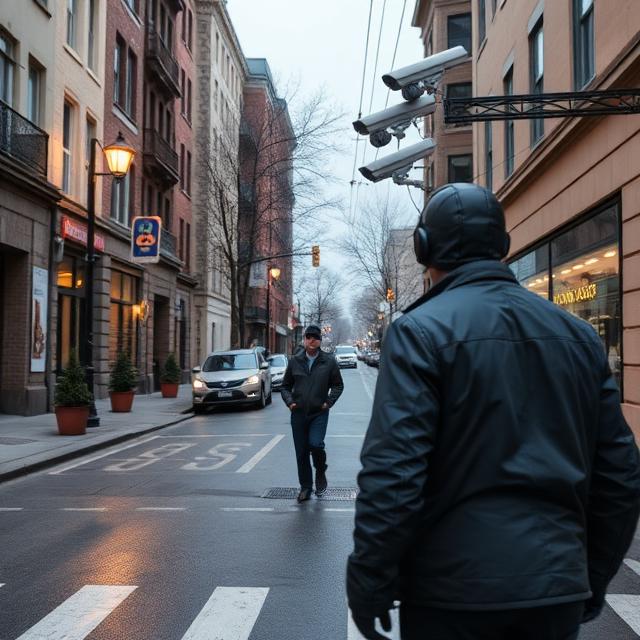
Facial recognition technology has moved from science fiction into everyday life. Once confined to airports, secure facilities and specialist investigations, it is now increasingly deployed across city centres, transport hubs, shopping districts, schools, sporting venues and other public spaces. Governments and law enforcement agencies frequently present these systems as essential tools for public safety, crime prevention and operational efficiency. However, their adoption raises fundamental questions about privacy, consent, data protection and the long term relationship between citizens and the state.
Supporters argue that facial recognition allows police and security agencies to identify wanted individuals, locate missing people and detect potential threats more quickly than traditional methods. Automated identification can reduce investigative workloads, improve response times and assist in reviewing the enormous volume of CCTV footage generated every day. For organisations operating with finite resources, the appeal is clear.
The concerns, however, extend well beyond questions of technical accuracy.
Unlike many other forms of surveillance, facial recognition converts a person’s face into a persistent biometric identifier. A face is not a password that can simply be changed after a data breach. Once compromised, biometric data is effectively permanent. Databases containing facial templates therefore represent exceptionally valuable targets for criminals, hostile states and other malicious actors.
The risks do not end with the images themselves. Modern artificial intelligence systems increasingly generate derived information from facial data, including estimated age, biological sex, emotional state, ethnicity, attention, fatigue and other inferred characteristics. While the scientific basis for many of these assessments remains disputed, they can nevertheless become part of an individual’s digital profile and influence automated decisions. Predictions, assumptions and probabilistic assessments may ultimately be treated as fact despite being inherently uncertain.
This creates a second layer of risk. Even where the original facial images are protected, the metadata and analytical conclusions generated from them may reveal considerably more about an individual than the photograph itself. Once created, these derived datasets may be retained, shared, combined with other databases or used for purposes entirely unrelated to the original reason for collecting the data.
From a data protection perspective, the challenge is substantial. Organisations deploying facial recognition must account not only for the images they capture but also for biometric templates, watch lists, confidence scores, audit logs, analytical outputs, model training data, software updates, third party processing, retention schedules and any onward sharing. Demonstrating effective oversight across systems of this complexity becomes increasingly difficult as deployments continue to expand.
The potential for abuse is equally significant. A system introduced to identify serious offenders today could, through changes in policy rather than technology, be expanded tomorrow to monitor peaceful demonstrations, track political opponents, identify journalists, profile minority communities or record the daily movements of ordinary citizens. History has repeatedly shown that surveillance capabilities, once established, rarely become less capable over time.
Perhaps the most contentious issue is consent. The overwhelming majority of people whose faces are scanned in public spaces have never explicitly agreed to participate in biometric surveillance. They were not asked whether they wished to have their faces converted into machine readable identifiers, compared against databases or analysed by artificial intelligence systems. Instead, deployment has largely been justified through legislation, regulatory interpretation or broad public safety arguments rather than through direct public approval.
Many critics argue that the widespread adoption of facial recognition has been driven by policy decisions influenced by sustained lobbying from policing, intelligence and security organisations. From their perspective, technologies that improve investigative capability and operational efficiency are naturally attractive. While those objectives are understandable, critics argue that they have too often taken precedence over careful consideration of civil liberties, proportionality and democratic accountability. Public debate has frequently followed deployment rather than preceded it, leaving many questioning whether decisions with significant societal consequences were ever subject to meaningful public scrutiny.
There is also a practical question that receives comparatively little attention: governance. As facial recognition systems become more widespread, who is responsible for monitoring every collection event, every database query, every algorithmic inference, every data transfer and every access request? Who audits the accuracy of watch lists, validates the assumptions generated by artificial intelligence or ensures that data collected in error is identified and deleted? The administrative burden grows alongside the scale and complexity of deployment.
If current trends continue, facial recognition may become an invisible layer of everyday infrastructure. Cameras supported by artificial intelligence could identify individuals continuously across transport networks, retail environments, workplaces and public spaces, linking movements into comprehensive records of behaviour. When combined with other sources of information including mobile devices, vehicle registration records, payment systems and online activity, the practical ability to remain anonymous in public may diminish significantly.
Whether society ultimately accepts this direction remains an open question. The debate is no longer simply about whether facial recognition works but about the kind of society its widespread adoption creates. The technology undoubtedly offers legitimate benefits for security and law enforcement, yet it also challenges long established expectations of anonymity, privacy and freedom of movement. As deployment continues across the world, the central question is not whether the technology is capable, but whether democratic societies can establish meaningful limits, transparent oversight and genuine accountability before comprehensive biometric surveillance becomes the norm rather than the exception.